
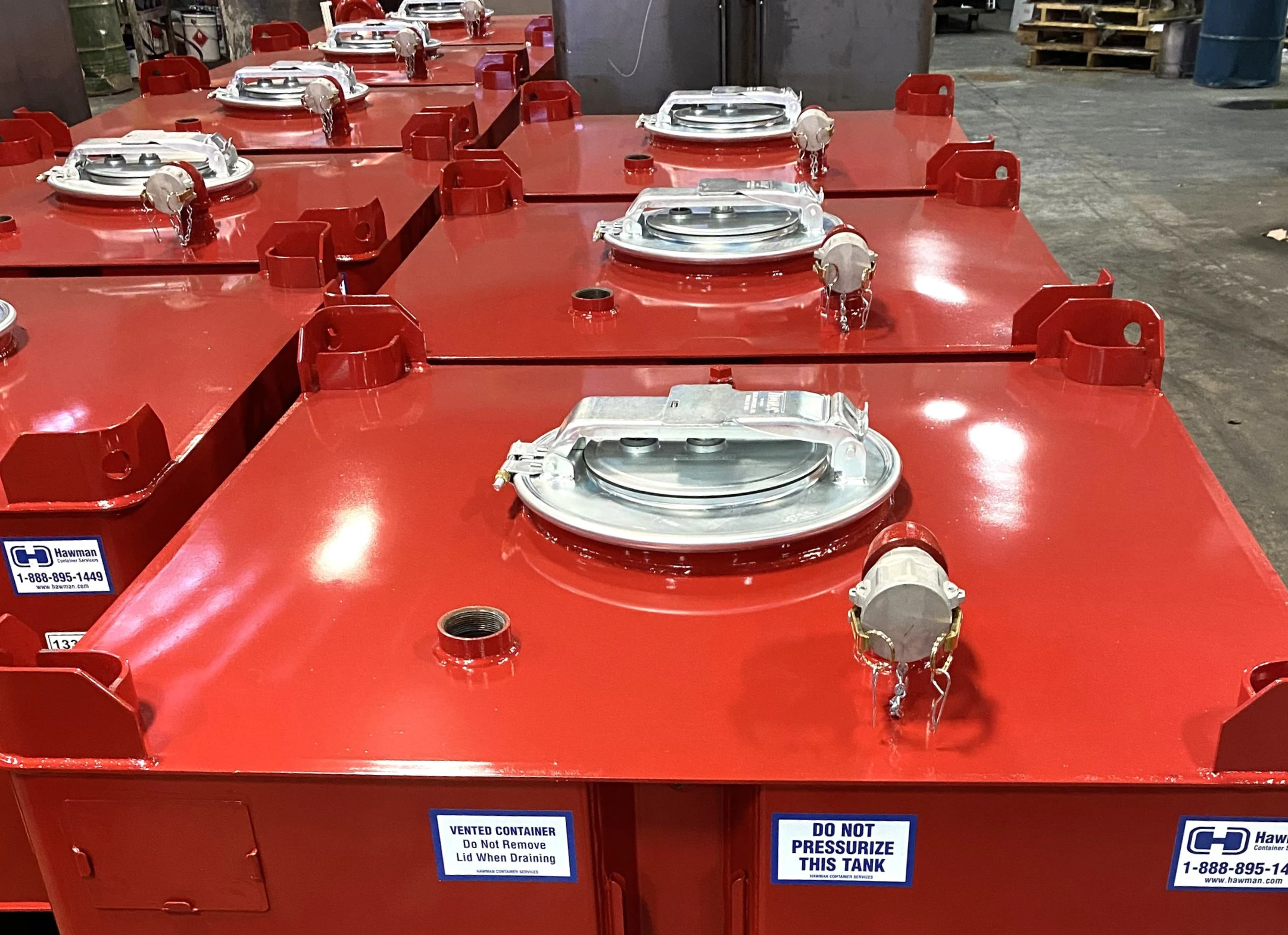
IBC Tote Chemical Compatibility
IBC Chemical Compatibility Chart: Which Tote Material for Your Chemical
A material selection reference for 59 industrial chemicals across composite (HDPE), carbon steel, 304 and 316L stainless IBCs — built by the engineering team at a Canadian UN-certified IBC manufacturer.
Chloride-bearing chemicals — hydrochloric acid, bleach, ferric chloride, brines — require HDPE composite IBCs, because chlorides pit every stainless grade. Oxidizers and food-grade products require 316L stainless. Hydrocarbons, caustics and concentrated sulfuric acid run safely in carbon steel. Concentration and temperature change the answer, so confirm every selection against the product SDS.
IBC Tote Chemical Compatibility Chart
Search by chemical name or filter by category. Every recommendation assumes ambient temperature, a dedicated single-product container, and a correctly specified valve and gasket. Where two materials are listed, the first is the more common industrial choice.
59 chemicals shown
| Chemical & concentration | TDG | Recommended | Do not use | Seal | Engineering notes |
|---|---|---|---|---|---|
| Acids | |||||
| Sulfuric acid ≤ 50%, dilute | 8 | HDPE composite | Carbon steel, 304 | EPDM, PTFE | Dilute sulfuric attacks steel aggressively — the opposite of concentrated. Vent for hydrogen evolution. |
| Sulfuric acid 93–98%, concentrated | 8 | Carbon steel, dedicated | 304, HDPE long-term | PTFE | Concentrated acid passivates carbon steel. Water ingress dilutes it and corrosion accelerates — keep sealed with a desiccant vent. |
| Hydrochloric acid all concentrations | 8 | HDPE composite | All steels, incl. 316L | PTFE, EPDM | Chlorides pit and stress-crack stainless. There is no steel grade that safely holds HCl in an IBC. |
| Nitric acid ≤ 68% | 8 (5.1) | 304L / 316L | Carbon steel, most elastomers | PTFE | Strong oxidizer that passivates stainless. Segregate from all organics and combustibles. |
| Phosphoric acid 75–85% | 8 | 316L or HDPE | Carbon steel, 304 | EPDM, PTFE | 316L strongly preferred above 40 °C. Food-grade service requires a sanitary finish. |
| Acetic acid glacial | 8 (3) | 316L | Carbon steel, 304 above 30 °C | PTFE | Freezes near 16 °C — insulate or heat trace for Canadian winter handling. |
| Acetic acid / vinegar ≤ 20% | 8 / NR | 316L or HDPE | Carbon steel, 304 | EPDM, PTFE | Acid plus free chloride in food brines rules out 304. |
| Hydrofluoric acid | 8 (6.1) | HDPE, PTFE-lined fittings | All steels, glass sight gauges | PTFE | Extreme personnel hazard. Dedicated container and dedicated fittings, never reassigned to another product. |
| Formic acid 85% | 8 | 316L or HDPE | Carbon steel, 304 | PTFE | Reducing acid — pressure can build from CO release. Vent required. |
| Citric acid solution | NR | 316L or HDPE | Carbon steel | EPDM, silicone | Food-grade service: 316L, sanitary fittings, documented cleaning protocol. |
| Sulfamic acid solution | 8 | HDPE or 316L | Carbon steel | EPDM | Common descaling chemistry — verify the inhibitor package, not just the acid. |
| Chromic / mixed plating acids | 8 (5.1, 6.1) | HDPE, PTFE-lined | Carbon steel, 304 | PTFE | Bath chemistry varies widely by shop. Submit the actual bath composition for review. |
| Caustics & bases | |||||
| Sodium hydroxide 50%, caustic soda | 8 | Carbon steel or HDPE | Aluminum, galvanized | EPDM, PTFE | 50% caustic crystallizes near 12 °C — insulate and heat trace for outdoor Canadian storage. |
| Sodium hydroxide ≤ 25% | 8 | HDPE or 304 | Aluminum, galvanized | EPDM | No heat tracing required at this concentration. |
| Potassium hydroxide 45% | 8 | Carbon steel, 304, HDPE | Aluminum, zinc | EPDM | Behaves much like caustic soda, with a lower crystallization point. |
| Ammonium hydroxide 19–29%, aqua ammonia | 8 (2.2) | 304 / 316L or HDPE | Copper, brass, bronze fittings | EPDM, PTFE | Vapour pressure rises sharply with temperature — pressure-rated closure, shaded storage. |
| Sodium carbonate soda ash solution | NR | Carbon steel, 304, HDPE | Aluminum | EPDM | Watch for scaling and settling in low-flow outlets. |
| Lime slurry Ca(OH)₂ | NR | Carbon steel or HDPE | — | EPDM | Abrasive and settles hard. Specify an oversized bottom outlet and plan for agitation. |
| Amines MEA, DEA, MDEA | 8 / NR | 304 / 316L or carbon steel | HDPE, Viton seals | PTFE, EPDM | Amines attack fluoroelastomers — a frequent seal-selection failure in gas treating service. |
| Oxidizers & water treatment | |||||
| Sodium hypochlorite 10–15%, bleach | 8 | HDPE composite only, vented | 304, 316L, carbon steel | Viton, PTFE | The most common material error we see. Bleach off-gasses, and its chlorides pit every stainless grade. Vented cap is mandatory. |
| Hydrogen peroxide 35–50% | 5.1 (8) | Passivated 316L or dedicated HDPE | Carbon steel, 304, any contamination | PTFE | Decomposes on contact with trace metals and generates pressure. Relief vent required; passivation certificate required for stainless. |
| Peracetic acid | 5.1, 8, 3 | HDPE vented, or passivated 316L | Carbon steel, 304 | PTFE | Same decomposition-pressure problem as peroxide, plus corrosivity. Never fill to 100%. |
| Chlorine dioxide solution | 5.1 (8) | HDPE vented, or 316L | Carbon steel | PTFE | Light-sensitive and unstable — opaque container, cool storage, short hold times. |
| Ferric chloride 40% | 8 | HDPE composite only | All steels | Viton, PTFE | Ferric chloride is the standard laboratory reagent for testing stainless pitting resistance. That tells you everything. |
| Ferric sulfate solution | 8 | HDPE | Carbon steel, 304 | EPDM, Viton | Stains heavily — specify an opaque or light-coloured composite bottle. |
| Aluminum sulfate alum | NR / 8 | HDPE or 316L | Carbon steel | EPDM | Mildly acidic in solution — carbon steel corrodes steadily even though the product looks benign. |
| Sodium bisulfite 38% | 8 / NR | HDPE or 316L | Carbon steel, 304 | EPDM, Viton | Oxygen scavenger — releases SO₂. Vent, and store away from acids. |
| Polymer / flocculant emulsion | NR | HDPE, 304, lined carbon steel | — | Viton | Oil-continuous emulsions swell EPDM. Extremely slippery when spilled — specify containment. |
| Urea / DEF 32.5%, AdBlue | NR | 304L / 316L or ISO 22241 HDPE | Carbon steel, copper, brass, zinc | EPDM, PTFE | Contamination, not corrosion, is the failure mode. Zinc or copper contact makes the fluid non-compliant and damages SCR systems downstream. |
| Solvents | |||||
| Acetone | 3 | 304 / 316L or carbon steel | HDPE, Viton seals | PTFE, EPDM | Class 3 flammable — bonding and grounding lugs required for transfer. |
| Methyl ethyl ketone MEK | 3 | 304 / 316L, carbon steel | HDPE, Viton | PTFE | Ketones destroy fluoroelastomer seals. PTFE only. |
| Toluene / xylene | 3 | 304, carbon steel | HDPE — permeation, ESC | Viton, PTFE | Aromatics permeate polyethylene over time. Weight loss and odour are the tell. |
| Methanol | 3 (6.1) | Carbon steel, 304, HDPE | Galvanized, aluminum, zinc | PTFE, Viton | Flammable and toxic. Widely used as a hydrate inhibitor in gas service — grounding is not optional. |
| Ethanol / isopropanol | 3 | 304, carbon steel, HDPE | — | Viton, PTFE | For USP or beverage-grade product, specify 304/316L with a sanitary finish. |
| Methylene chloride | 6.1 | 316L | HDPE, most elastomers | PTFE | High density — check the container's specific-gravity rating before filling. |
| Mineral spirits / naphtha | 3 | Carbon steel, 304 | HDPE — permeation | Viton, Buna-N | Standard Class 3 flammable-liquid handling controls apply. |
| Glycol ether solvents | 3 / NR | 304 / 316L | HDPE — varies by ether | PTFE | Compatibility differs significantly between E-series and P-series. Send the specific product. |
| Styrene / unsaturated resin | 3 | 304, lined carbon steel | HDPE | Viton | Polymerization risk — inhibitor level and temperature matter more than the metal. Limit storage time. |
| Hydrocarbons & oilfield | |||||
| Diesel / heating oil | 3 | Carbon steel, 304 | — | Viton, Buna-N | The most forgiving product on this chart. Watch water bottoms and microbial growth on long holds. |
| Gasoline / condensate | 3 | Carbon steel, bonded & grounded | HDPE for transport | Viton | Static accumulation is the primary hazard. A metallic IBC with grounding provisions is the correct specification. |
| Crude oil / oilfield emulsion | 3 | Carbon steel | — | Viton, Buna-N | Insulate and heat trace for cold-weather viscosity. Specify a large-bore bottom outlet. |
| Produced water / brine | NR / 9 | HDPE or coated carbon steel | 304 — chloride pitting | Viton, EPDM | Chloride content is often high enough to pit 304 within a single season. |
| Completion brines CaCl₂, KCl | NR | HDPE or lined carbon steel | 304 / 316L in hot brine | Viton | Heavy — verify the container's 1.9 specific-gravity rating against the brine density. |
| Acidizing fluid 15% HCl blend | 8 | HDPE, PTFE-lined fittings | All steels | PTFE | Inhibited or not, this is still hydrochloric acid. No metallic IBC. |
| Lubricants / hydraulic oil | NR | Carbon steel, 304, HDPE | — | Buna-N, Viton | Cleanliness drives the spec. A dedicated container with a sealed closure protects ISO cleanliness codes. |
| Used / waste oil | 9 / NR | Carbon steel | — | Buna-N | Unknown contaminants are the real risk. Provincial waste regulations may govern container marking. |
| Ethylene / propylene glycol | NR | Carbon steel, 304, HDPE | Galvanized | EPDM | Zinc contamination degrades inhibitor packages in coolant service. |
| Mining reagents & explosives | |||||
| Ammonium nitrate emulsion matrix | 5.1 | 304 / 316L, insulated & heat traced | Carbon steel, copper, zinc, lead | PTFE, EPDM | Contamination control is a safety issue, not a quality issue. Copper, chlorides and carbonaceous material can sensitize the product. Temperature must stay above the crystallization point in transit. |
| Ammonium nitrate solution ~83% | 5.1 | 304L / 316L | Carbon steel, copper alloys | PTFE | Crystallizes near 60 °C at this strength — heated or jacketed storage is required, not optional. |
| Sodium cyanide solution 20–30% | 6.1 | Carbon steel or 304, pH > 11 | Any acid contact, aluminum | EPDM | Alkalinity is the control. Acid contact generates hydrogen cyanide gas — segregation from all acid loads is mandatory in transport. |
| Xanthate flotation collectors | 4.2 | Carbon steel, 304 | Moisture, heat sources | EPDM | Self-heating substance. Decomposes with moisture and heat, releasing carbon disulfide. Sealed, cool, dry storage only. |
| Frothers & collector blends | 3 / NR | Carbon steel, 304, HDPE | — | Viton | Blend-specific. Alcohol frothers and glycol frothers behave differently against elastomers. |
| Mine water treatment reagents | varies | HDPE or 316L | Carbon steel | EPDM | Site water chemistry varies enormously — assume chlorides are present unless assayed. |
| Food & beverage | |||||
| Coconut oil | NR | 304 / 316L, insulated + heat traced | Carbon steel | Silicone, PTFE | Solid below roughly 24 °C. A jacketed or heat-traced stainless IBC with a full-bore bottom outlet is the difference between a pumpable load and a solid block at the receiving dock. |
| Edible oils canola, soy, sunflower | NR | 304 / 316L sanitary | Carbon steel, copper alloys | Silicone, PTFE | Sanitary finish and documented CIP protocol. Copper catalyzes oxidation and rancidity. |
| Palm / palm kernel oil | NR | 304 / 316L, insulated + heat traced | Carbon steel | Silicone, PTFE | Same thermal handling profile as coconut oil. |
| Liquid sugar / corn syrup | NR | 304 / 316L sanitary | Carbon steel | Silicone | Keep warm to prevent crystallization; microbial growth risk at dilute interfaces. |
| Honey / molasses | NR | 316L, heat traced | Carbon steel | Silicone | Very high viscosity — outlet sizing and discharge temperature drive the design. |
| Fruit juice concentrate | NR | 316L | 304, carbon steel | Silicone, PTFE | Acidity plus chloride content makes 304 a false economy here. |
| Vinegar & acidified brines | NR | 316L | 304, carbon steel | PTFE | The worst of both worlds for stainless: low pH and free chlorides. |
| Glycerin USP | NR | 304 / 316L, HDPE | — | EPDM, silicone | Hygroscopic — a sealed closure protects the assay. |
| Detergents & surfactants | 8 / NR | HDPE, 304 | Aluminum | EPDM | Check the pH and chloride content of the formulation, not the product category. |
No match in the chart. Your chemical may still be a routine build for us — send us the SDS and we'll spec it.
The Four IBC Materials & When Each One Wins
Composite / HDPE
A blow-moulded polyethylene bottle in a welded steel cage. The default answer for anything chloride-bearing, hydrochloric acid, bleach, ferric chloride, brines, because chlorides attack every stainless grade. Also the economical choice for dilute acids and water treatment chemicals.
Weak against aromatic and chlorinated solvents, which permeate polyethylene over time. Shorter service life than metal, and UV exposure matters.
Composite IBC totes →Carbon Steel
The workhorse for hydrocarbons, fuels, lubricants, caustics and concentrated sulfuric acid. Rugged, repairable, groundable for flammable service, and the lowest cost per year of service life in heavy industrial duty.
Wrong for oxidizers, dilute acids, chlorides, and any product where iron pickup contaminates the load, DEF being the classic example.
Carbon steel IBC tanks →304 Stainless
Good general corrosion resistance at lower cost than 316L. Suits nitric acid, caustics, alcohols, ketones, ammonia solutions and non-chloride food products.
The line to watch is chlorides. Anything with free chloride, seawater, brines, acidified food products, produced water, will pit 304, often faster than buyers expect.
Stainless steel IBC tanks →316L Stainless
The molybdenum addition buys meaningful pitting resistance. This is the grade for phosphoric and acetic acid, passivated hydrogen peroxide service, food and beverage, pharmaceutical intermediates, and anything acidic carrying trace chlorides.
316L is not chloride-proof. It is better than 304, not immune, concentrated chloride service still belongs in HDPE.
Metal IBC totes →Gasket & Seal Compatibility
Container material gets specified carefully and the gasket gets whatever is on the shelf. In our experience that is where most IBC "compatibility failures" actually originate — the vessel is fine, and the valve seat has swollen, hardened or dissolved.
| Elastomer | Good service | Fails against | Typical range |
|---|---|---|---|
| EPDM | Acids, caustics, water treatment chemicals, glycols, ketones, hot water and steam | Petroleum products, mineral oils, aromatic solvents | −40 to 120 °C |
| Viton / FKM | Hydrocarbons, fuels, chlorinated solvents, strong oxidizers, aromatics | Ketones, amines, hot water and steam, esters | −20 to 200 °C |
| PTFE | Near-universal — the fallback when nothing else is compatible | Molten alkali metals; poor compression recovery, re-torque after the first thermal cycle | −50 to 200 °C |
| Buna-N / nitrile | Petroleum oils, diesel, hydraulic fluids, lubricants, greases | Oxidizers, ketones, strong acids, ozone exposure | −30 to 100 °C |
| Silicone | Food-grade service, wide temperature swings, edible oils | Most solvents, steam, concentrated acids; poor abrasion resistance | −55 to 200 °C |
TDG Certification, and How to Read a UN Marking
Compatibility is one half of the specification. If the product is a regulated dangerous good, the container also has to be the right certified container. Under the Transportation of Dangerous Goods Regulations and CAN/CGSB-43.146, an IBC carrying dangerous goods must hold a valid UN design-type certification appropriate to the product's class and packing group, and that certification is stamped on the plate.
| Marking | What it means |
|---|---|
| 31A | Design type, metal IBC for liquids. Composite units read 31HA1: rigid plastic inner, steel outer. |
| Y | Tested for packing groups II and III. An X-marked unit covers all three groups; a Z-marked unit covers packing group III only. |
| 03 26 | Month and year of manufacture, the clock that periodic inspection and retesting run against. |
| CAN | State authorizing the design type. |
| M5678 | Manufacturer and certification identifier. |
| 1500 | Stacking test load in kilograms. Zero means the unit is not designed to be stacked in transport. |
| 1250 | Maximum permitted gross mass in kilograms. |
A container certified against a 1.2 specific gravity product is not automatically valid for a 1.6 SG product, and certification carries ongoing obligations: a leakproofness inspection every 2.5 years and a full periodic retest every 5 years, with records retained. A container past its date is not a paperwork technicality, it is out of service.
Compliance & regulations overview · IBC testing & recertification services
What a Compatibility Chart Cannot Tell You
Every chart on the internet, this one included, is a starting point. Five things move the answer, and none of them fit in a table cell.
Temperature
Corrosion rates roughly double every 10 °C. A material rated acceptable at 20 °C can be unusable at 60 °C. Acetic acid on 304 is the standard example — fine cold, a problem warm.
Concentration
Sulfuric acid is the clearest case on this page: carbon steel handles 98% acid and is destroyed by 20% acid. The direction is not intuitive and varies by chemistry.
Trace contaminants
A few hundred ppm of chloride in an otherwise compatible product will pit stainless. Process water, recycled solvent and site-blended reagents are the usual sources.
Permeation and time
Polyethylene passes solvents slowly. Nothing looks wrong for weeks. Then bottle weight drops, the cage stains, and the product assay drifts.
The previous load
Residue plus a new product is how IBCs rupture — hypochlorite meeting acid being the classic pairing. This is the argument for dedicated containers and documented cleaning.

Not sure? Send us the Safety Data Sheet
Our engineering team reviews chemical compatibility, container material, gasket selection and UN certification requirements at no charge — including for chemicals that aren't on this chart. We've been building IBCs in Barrie, Ontario for over 40 years, and we'd rather spec it correctly than sell you the wrong container.
Frequently Asked Questions
-
Dilute sulfuric acid, under about 50%, is well suited to an HDPE composite IBC — better suited than to steel, which dilute acid attacks aggressively. Concentrated sulfuric acid at 93–98% is the opposite case: it passivates carbon steel and is conventionally stored in dedicated carbon steel containers, while long-term storage in polyethylene is generally not recommended. Concentration determines the answer.
-
A vented HDPE composite IBC. Sodium hypochlorite off-gasses and generates pressure, so a vented closure is required, and its free chlorides pit stainless steel including 316L. Do not use any metal IBC for bleach, and treat the container as dedicated — hypochlorite residue reacting with an acid load produces chlorine gas.
-
No. 304 has no molybdenum and is susceptible to chloride pitting and chloride stress corrosion cracking, sometimes at only a few hundred ppm and accelerating sharply with temperature. Use 316L for trace-chloride service, and HDPE for genuinely chloride-rich products such as brines, ferric chloride and hydrochloric acid.
-
Choose 304/304L for nitric acid, caustics, alcohols, ammonia solutions and non-acidic food products, where it gives the same service at lower cost. Choose 316L when the product is acidic, contains any chloride, is an oxidizer such as hydrogen peroxide, or is a food or pharmaceutical product where a pitted surface becomes a contamination issue. When the two are close on paper, the price difference is usually smaller than the cost of one premature replacement.
-
No. Hydrochloric acid corrodes carbon steel rapidly at every concentration and pits stainless steel of any grade. HCl service requires an HDPE composite IBC with PTFE-lined or plastic fittings, and inhibited acidizing blends used in oilfield service are no exception.
-
IBCs used for dangerous goods require a leakproofness test and inspection every 2.5 years and a full periodic retest every 5 years, with records retained. An IBC past either date cannot legally be used to transport dangerous goods until it has been retested and re-marked.
-
Send us the Safety Data Sheet along with your service temperature, concentration and expected hold time. Our engineering team will specify container material, gasket, valve and certification requirements — most industrial chemistries are routine builds for us, and the ones that aren't are usually the interesting projects.