
Emulsion Explosive IBC Totes
Built for Mining
Mining Emulsion Explosives IBCs
Purpose-built for the storage, transport, and handling of viscous emulsified products in underground and surface mining environments.
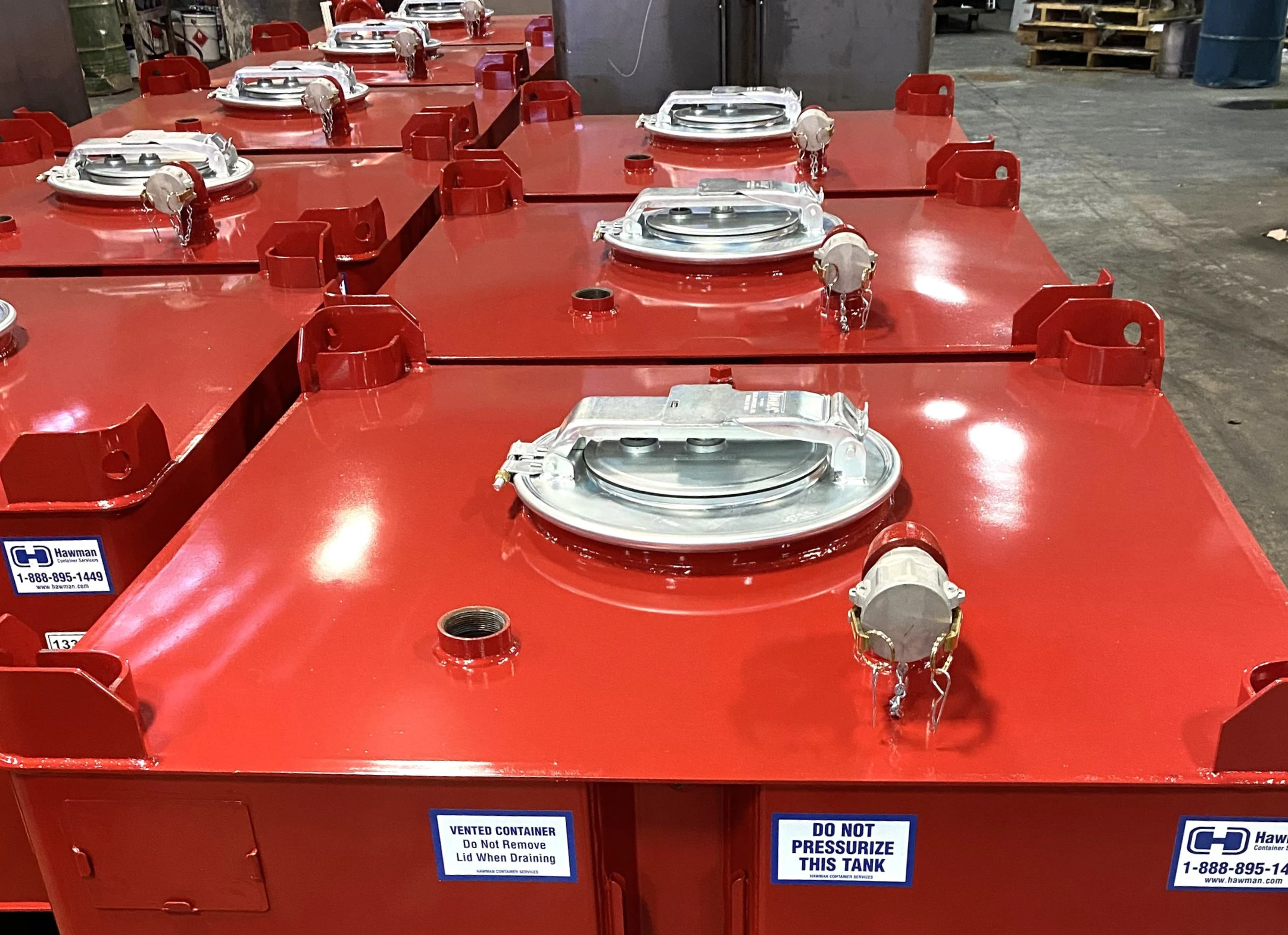
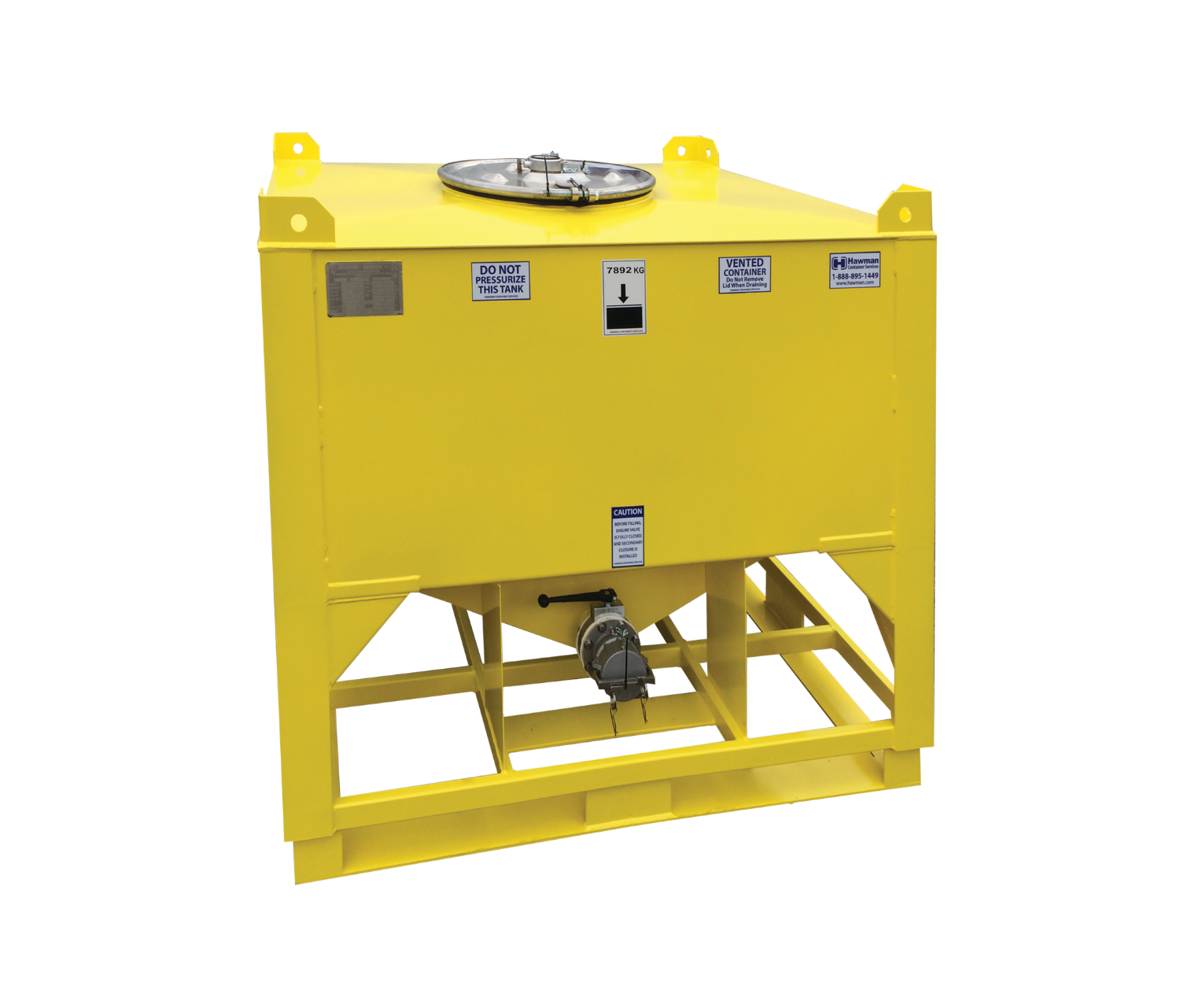
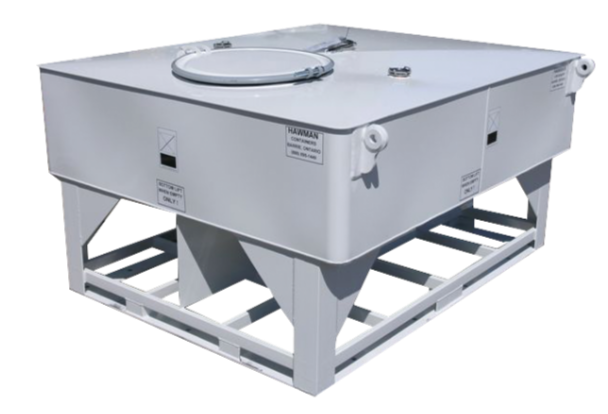
Hawman Container Services' Emulsion Totes are engineered specifically to meet the demands of the mining industry. Manufactured from 304L stainless steel or carbon steel (optional 316L), these low-profile, hopper-bottom IBCs provide reliable discharge, durability, and operational efficiency in confined underground environments.
With larger 48" × 60" and 60" × 72" footprints and low-profile height, Emulsion Totes are designed for low mine-shaft clearances while maintaining full UN31A transport compliance — making them ideal for emulsion explosives, viscous lubricants, and other high-density fluids.
Hawman Container Services is the only Canadian manufacturer of UN31A-certified steel IBC totes approved specifically for emulsion explosive transport with 24+ Transport Canada-approved designs. No other domestic manufacturer offers this.
✔ 40+ Years In-House Manufacturing
✔ 24+ Transport Canada Approved Designs
✔ 100,000+ sq. ft. Dual Facility — Barrie, Ontario
✔ Exclusive Canadian Manufacturer for Emulsion IBCs
✔ Remote Mine Site Delivery Available



Hawman Container Services is the only Canadian manufacturer of UN31A-certified steel IBC totes approved specifically for emulsion explosive transport
Key Applications
Emulsified explosives and blasting agents
Viscous lubricants and oils
Mining chemical products
High-density fluids for underground operations
Why Emulsion IBCs Are Different
General hazmat-rated IBCs do not qualify for emulsion explosive transport. The combination of high viscosity, density up to 1.9 SG, and Class 1 classification requires containers that have passed UN31A's full test protocol — including hydrostatic pressure, drop, stacking, and lift tests — at the design stage.
Procurement teams that source "chemical-rated" or "hazmat-approved" IBCs without confirming UN31A Class 1 approval routinely discover the compliance gap at site inspection — at significant operational cost.
Engineering Advantages
Key Benefits of Hawman Emulsion IBC Totes
Every design decision in Hawman's Emulsion Tote addresses a real operational challenge in underground mining logistics and viscous emulsion handling.
🔻 Hopper-Bottom Design
A 25° angled bottom supports efficient discharge of viscous emulsions, reducing product hang-up, minimizing waste, and speeding up transfer at the point of use.
📏 Low-Profile Configuration
Optimized height allows easier handling under mine-shaft ceilings and in tight operational areas where standard IBC footprints do not fit.
🔩 Rugged Construction
Heavy-duty 304L stainless steel or carbon steel provides long-term durability in harsh mining environments with repeated handling and chemical exposure.
✅ UN31A-Certified
Full UN31A Transport Canada certification supports over-the-road and on-site compliance for hazardous and non-hazardous viscous liquids, including emulsion explosive transport.
🚜 Operator-Friendly
Standard four-way forklift entry and well-positioned vents simplify movement and handling in underground corridors and surface staging areas.
🔧 Customizable
Available in 316L stainless steel for highly corrosive applications, with alternative valve configurations, lid styles, and custom outlet sizing for specific site requirements.
Standard Features & Specifications
All Hawman Emulsion Totes are manufactured in-house with no outsourced components. Every specification below applies to standard configurations; custom builds are available.
| Component | Specification |
|---|---|
| Lid | 22.5" stainless steel eyebrow-style lid with Buna or EPDM gasket and stainless steel bolted ring closure |
| Fill Cap | 3" stainless steel fill/fusible cap centered in lid |
| Vent | 2" polyethylene pressure and vacuum relief vent |
| Bottom Design | 25° hopper bottom to forward-facing 3" butterfly valve (4" optional) |
| Valve | 3" aluminum TTMA butterfly valve with 3" aluminum camlock and dust cap |
| Forklift Access | Standard 4-way forklift entry |
| Footprint Options | 48" × 60" or 60" × 72" |
| Profile | Low-profile design, optimized for underground mine use |
| Certification | UN31A — Transport Canada approved |
| Primary Material | 304L Stainless Steel or Carbon Steel |
Optional Equipment & Upgrades
316L Stainless Steel construction— for highly corrosive applications with aggressive emulsion formulations
Stainless steel valve with female couplers— for applications requiring superior chemical resistance
Alternative lid styles— available from 8" to 22.5" depending on fill and access requirements
Custom outlet sizing— for non-standard emulsion viscosities or dispensing equipment
Heated jacket systems— for cold-climate emulsion stability in northern Canadian operations
Integrated pump mounts— for turnkey dispensing configurations
Industries & Applications
Hawman's Emulsion IBCs are deployed across every major Canadian mining and blasting segment — from fly-in underground mines to open-pit oilsands and quarry blasting programs.
-
⛏️
Underground Hard Rock Mining
Low-profile IBC totes designed for mine-shaft clearances — compliant storage and transport of emulsion explosives in confined underground corridors.
-
🏔️
Open-Pit Mining Operations
UN31A certified IBC tanks for bulk emulsion explosive storage at open-pit mine sites across Canada, including oilsands and gold mining operations.
-
🛢️
Oilsands Blasting Programs
Heavy-duty steel IBC containers rated for seasonal temperature extremes — built for surface staging and batch delivery to pump trucks in Alberta oilsands operations.
-
💥
Quarry & Construction Blasting
Transport Canada approved IBC totes for emulsion blasting agents used in aggregate quarrying, road construction, and demolition blasting across Canada.
-
🧪
Viscous Lubricants & Mining Chemicals
Hopper-bottom IBC design ensures complete discharge of high-viscosity mining chemicals, lubricants, and process fluids — reducing waste and downtime.
-
✈️
Remote Fly-In/Fly-Out Mine Sites
Hawman ships certified emulsion explosive IBCs to remote northern Canadian mine sites in Ontario, Nunavut, and beyond — where no other compliant domestic supplier delivers.
-
🌍
International Mining Operations
Canadian UN31A certification is recognised under the UN Model Regulations framework — accepted for emulsion explosive transport in West Africa, South America, and Southeast Asia.
UN31A Certification & TDG Compliance: What Your IBC Must Actually Meet
Understanding what UN31A actually requires helps procurement teams ask the right questions and evaluate suppliers accurately.
UN31A is the international UN specification for rigid metal IBCs designed to transport liquid dangerous goods with a specific gravity up to 1.9 — directly relevant to emulsion explosives. Under Canada's TDG Regulations (SOR/2001-286), any IBC used to transport Class 1 explosives must display a valid UN certification mark that matches the container's design type, held by the manufacturer — not the buyer or distributor.
Under Canada's TDG Regulations, an IBC transporting emulsion explosives must be UN31A certified, with the design approval held by the manufacturer and verifiable through Transport Canada's approval registry. A UN mark stamped on the container isn't sufficient on its own.
UN31A Test Protocol
To achieve type approval, a container design must pass every element of the following battery — not just most of them:
- Hydraulic pressure test at 1.5× maximum allowable working pressure
- Bottom-lift test at 6× maximum gross mass
- Top-lift test
- Stacking test at 1.8× gross mass held for 5 minutes
- Drop test from 0.8 metres
- Leakproofness test
Required Container Marking
TDG requires a permanently embossed or stamped UN31A designation directly on the container body.
- UN packaging symbol
- Design type (31A)
- Material group
- Maximum gross mass
- Year of manufacture
- Country of approval & manufacturer code
Adhesive labels do not satisfy TDG marking requirements for dangerous goods packaging.
Steel vs. Polyethylene IBCs
Steel construction is required for emulsion explosive applications due to resistance to static discharge, deformation, and thermal stress.
Polyethylene and composite IBCs cannot reliably meet UN31A test protocols for Class 1 dangerous goods.
Read: Steel vs Poly IBC Comparison →Stainless vs. Carbon Steel
Stainless Steel (304L / 316L) offers superior corrosion resistance for ammonium nitrate-based emulsions.
Carbon Steel is a cost-effective solution for short-cycle transport applications.
Certifications Hawman IBCs Hold

Engineered for underground mining environments where a container failure isn't a product loss — it's a safety crisis.
Canada's Only Source for Compliant Emulsion Explosive IBCs
Hawman Container Services is the exclusive Canadian manufacturer of IBCs certified for emulsion explosive transport. No other domestically produced UN31A container for Class 1 explosive emulsions exists in the Canadian market. That has direct implications for procurement teams who need a defensible, auditable supply chain for a safety-critical application.
100% In-House Manufacturing
Raw steel plate enters one end and a certified, marked, tested emulsion IBC exits the other — no outsourced fabrication steps. Compliance documentation traces back to a single source.
24+ Transport Canada Approved Designs
A verified selection of configurations suited to different emulsion explosive volumes and site-specific handling requirements — all within a certified manufacturing framework.
In-House Recertification
Hydrostatic testing, structural inspection, and TDG re-marking are all handled internally, compressing the recertification cycle for procurement teams.
Remote Delivery Capability
Hawman ships certified IBCs to northern Canadian mine sites and global operations across West Africa, South America, and Southeast Asia.
40+ Years Field-Proven Durability
Many Hawman IBCs remain in service for decades, reducing total cost of ownership versus imported containers requiring frequent replacement.
Custom Engineering Available
Non-standard viscosities, heating systems, and specialised valve configurations are supported through Custom Process Equipment within the same certified framework.

40+ Years of IBC Expertise
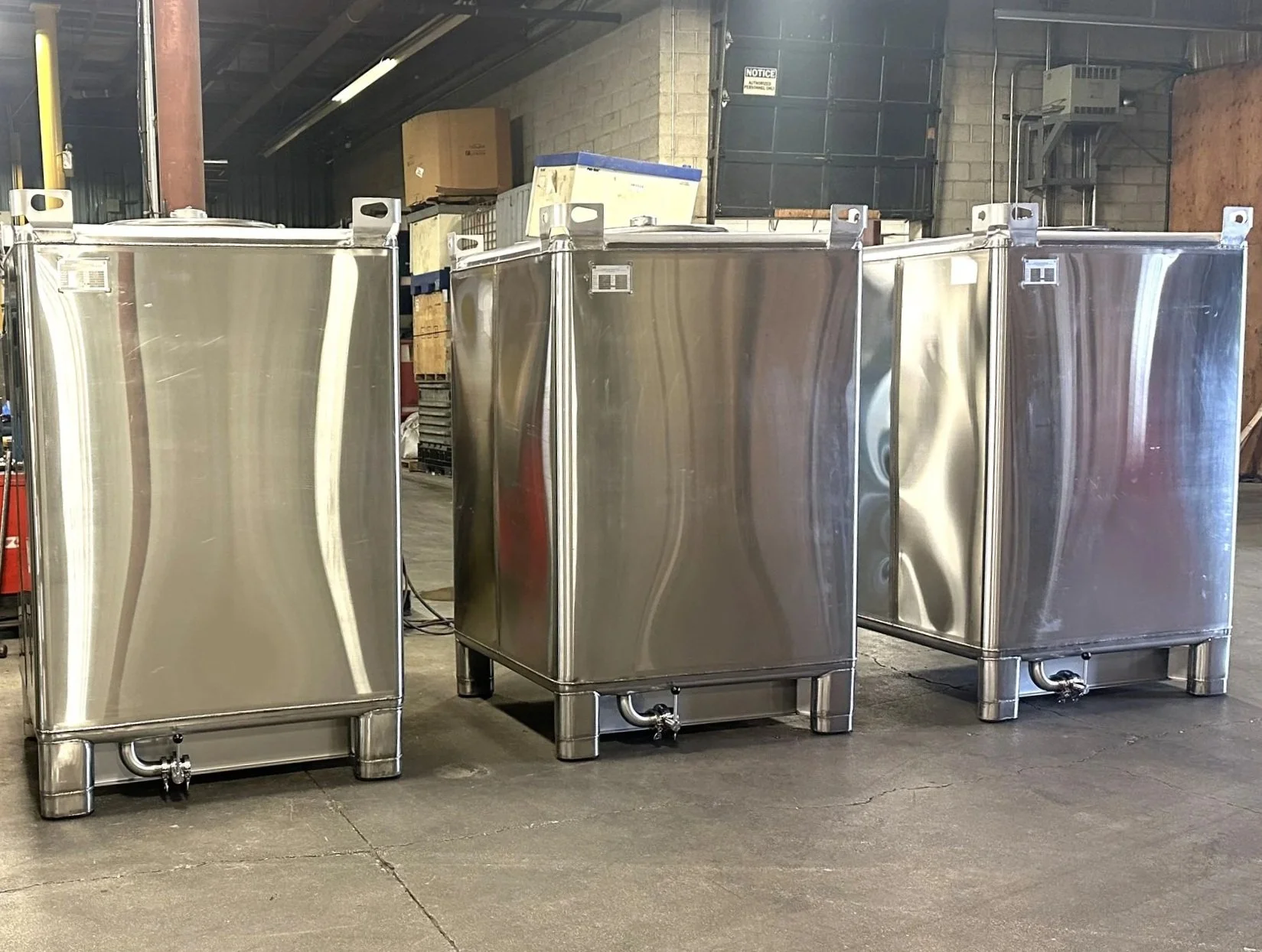
Custom Engineered Emulsion IBC Totes
Not every mining operation runs on standard specs. Hawman's in-house engineering team designs and fabricates custom emulsion IBC totes for operations with non-standard requirements — all within the same certified manufacturing framework as our standard UN31A product line.
Custom configurations include heated jacket systems for cold-climate emulsion stability, integrated pump mounts for turnkey dispensing, alternative valve and outlet sizing for high-viscosity formulations, and specialised footprints for non-standard underground corridor dimensions.
Every custom build is manufactured entirely in-house in Barrie, Ontario — no outsourced fabrication, no broken certification traceability, and no compromise on UN31A compliance.
IBC Totes for Emulsion Explosives — FAQ
-
Any IBC used to transport emulsion explosives in Canada must carry UN31A certification under the Transportation of Dangerous Goods (TDG) Regulations. UN31A designates a rigid metal IBC that has passed the full suite of UN performance tests — including drop, stacking, leakproofness, and hydraulic pressure — at the design qualification stage.
The certification mark must appear on the container itself, and the manufacturer must hold a Transport Canada design approval certificate for that specific IBC model. A general chemical or hazmat rating is not sufficient for Class 1 explosive materials.
-
No. Polyethylene and composite IBCs cannot meet the structural and certification requirements for Class 1 dangerous goods under Canada's TDG Regulations. Emulsion explosives require UN31A-certified rigid metal IBCs — either stainless steel or carbon steel — because metal construction provides the drop resistance, stacking strength, and hydraulic pressure tolerance required at the gross mass ratings of explosive emulsion applications.
See our Steel vs Poly IBC Containers comparison for a full breakdown.
-
Under Canada's TDG Regulations, IBCs used for dangerous goods must be inspected and recertified at prescribed intervals — typically every 2.5 years for periodic inspection and every 5 years for full recertification, though the exact schedule depends on the container's design type and the materials transported.
Containers that fail recertification must be removed from explosive service immediately. Hawman's IBC Testing & Recertification Services are specifically designed to keep containers legally serviceable through this process.
-
Yes. Hawman Container Services is the exclusive Canadian manufacturer of UN31A-certified steel IBC totes approved for emulsion explosive transport. With over 24 Transport Canada approved IBC designs and 40+ years of in-house manufacturing expertise, Hawman is the only domestically produced source for compliant emulsion explosive IBCs in Canada. All containers are manufactured entirely in-house at the Barrie, Ontario facilities with no outsourcing.
-
UN31A certification is valid for five years from the date of manufacture stamped on the container — not from the date of first use. A tote sitting in warehouse storage for two years before deployment enters the field with only three years of active certification remaining.
Once the five-year period expires, the container must be withdrawn from dangerous goods service and submitted for full recertification inspection before it can be returned to emulsion explosive transport.
-
Yes. Hawman ships certified IBCs to remote locations across Canada, including northern and fly-in mine sites where standard industrial supply chains aren't practical. For remote operations, sourcing directly from Hawman with confirmed delivery capability is a critical risk management consideration — if a non-compliant IBC reaches a fly-in mine site and gets flagged, replacement lead times through remote logistics corridors can stretch to weeks, halting blasting programs entirely. -
Yes, in most jurisdictions. Transport Canada's UN31A type approval framework aligns with the UN Model Regulations that underpin international dangerous goods codes including IMDG (sea), ADR (European road), and national TDG frameworks in over 50 countries. This makes a single Canadian-certified container generally usable across West Africa, South America, Southeast Asia, and other active mining regions. Procurement teams should verify local requirements for specific destination countries where autonomous national dangerous goods legislation applies.
-
A damaged emulsion IBC tote must be immediately withdrawn from service. Damage that voids UN31A certification includes dents exceeding TDG dimensional tolerances, cracking or porosity in welded seams, valve or fitting damage compromising the pressure rating, and corrosion reducing wall thickness below the certified minimum.
The container cannot be returned to emulsion explosive transport until it passes a full recertification inspection — including hydrostatic pressure testing and structural assessment — through a qualified facility such as Hawman's in-house recertification service.

Need Compliant Emulsion Explosive IBCs?
Talk to Canada's only certified manufacturer. Our team can provide Transport Canada design approval documentation, quote configurations for your specific emulsion application, and confirm delivery to your site — remote or otherwise.