
Choosing between a steel IBC and a poly IBC is not about which container is better; it is about which one is right for what you are storing. The answer depends on your product, your process temperatures, your safety obligations, and how long you plan to run the asset.
Steel IBCs are welded metal vessels made from carbon steel or stainless steel. Polyethylene IBCs, or composite IBCs, use a blow-moulded HDPE liner housed inside a galvanized steel cage. Both serve the same basic function: storing and transporting bulk liquids at industrial scale. But they perform very differently under pressure, heat, fire, and chemical exposure.
Picking the wrong type is not just a procurement mistake. It can mean a compliance failure, a chemical release, a fire incident, or a container that fails years before it should. Hawman Container Services manufactures both UN-certified metal and composite IBCs in Ontario and works with industrial operators to match the right container to the right application.
This guide covers materials, performance, cost, industry fit, and a decision framework to help you make a confident call.
Key Takeaways
Steel IBCs are required for Class I flammable liquids and high-temperature processes — Polyethylene IBCs are not appropriate for these applications
Poly IBC totes cost significantly less upfront ($200–$500) but have a shorter service life of 5–10 years; steel IBCs cost more ($3,000–$5,000+) but commonly last 25 years or more
HDPE liners soften and can fail at temperatures above 60°C — a critical limit for any hot-fill or heated storage application
Both steel and poly IBC tanks can be UN-certified for hazardous goods transport, but material suitability must be verified per chemical class
Total cost of ownership often favours steel for high-throughput, long-term operations
What Is an IBC Container?
IBC stands for Intermediate Bulk Container. It is a reusable industrial container designed for the storage and transport of bulk liquids and some flowable solids. Standard capacities run from roughly 500 L to 1,250 L — that is approximately 130 to 330 US gallons — putting them between drums and fixed storage tanks in terms of volume.
IBCs are forklift-accessible, stackable, and built for efficient warehouse or yard storage. They are widely used across chemical manufacturing, food processing, agriculture, oil and gas, and pharmaceutical operations.
There are two main types covered in this article:
Metal IBCs (UN31A): Carbon steel or stainless steel vessels with welded construction. Available with heating systems, insulation, and various valve configurations. Built to handle high-risk chemicals, flammable liquids, and high-temperature applications.
Composite / Poly IBCs (UN31HA1): A blow-moulded HDPE inner liner inside a galvanized steel cage, with plastic valves, caps, and an integrated pallet base. Sometimes called cage IBCs or totes in industrial settings.
Understanding the basic construction of each type makes it easier to see why material choice affects performance, safety, and cost so significantly.
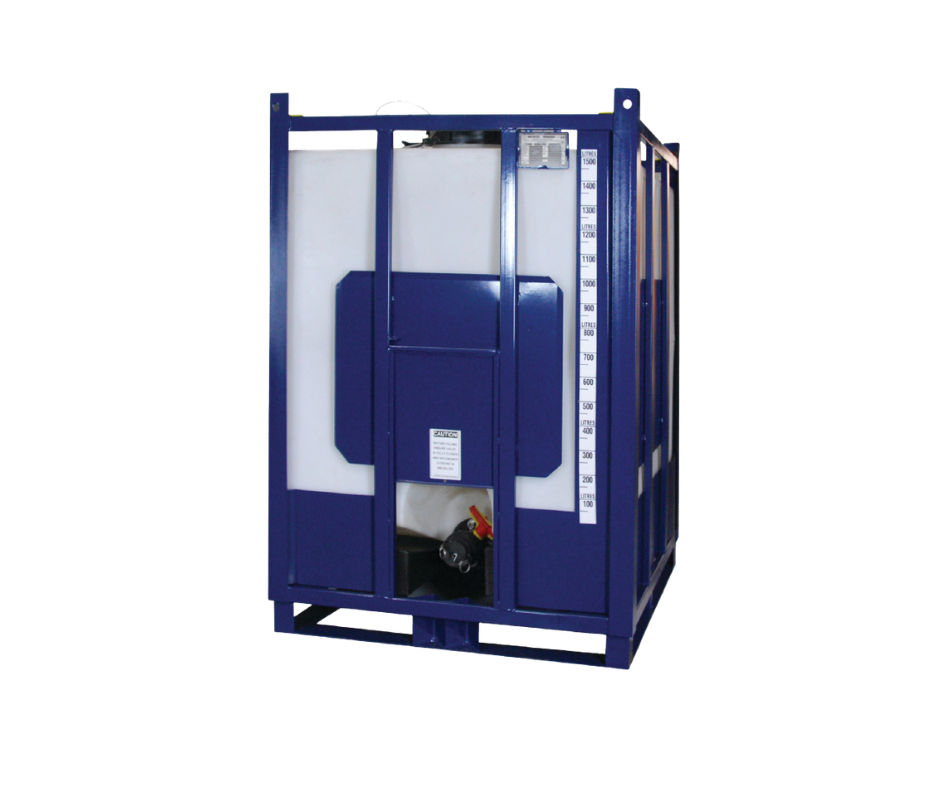
Polyethylene IBC Containers - Benefits, Limitations, and Best Uses
How They Are Built
A poly IBC consists of a blow-moulded HDPE liner inside a galvanized steel cage, mounted on an integrated pallet base. Valves and fittings are typically plastic. Common capacities are 500 L, 1,000 L, and 1,250 L. UN31HA1 certification is available when design requirements are met.
Key Benefits
Poly IBCs have a lot going for them, especially for operations with tight capital budgets or moderate-risk storage needs.
Low upfront cost: Typically $200–$500 per unit
Lighter weight: Reduces freight costs and simplifies handling compared to steel
Broad chemical resistance: HDPE resists many acids, alkalis, and common industrial chemicals at ambient temperatures
Food-grade options: Virgin resin liners are widely used for edible oils, syrups, and similar products
Wide availability: Common sizes are stocked by many suppliers across Canada
Limitations and Risks of Polyethylene IBCs
This is where polyethylene IBCs run into real problems for certain applications.
The temperature ceiling is the most important limitation to understand. HDPE has a continuous-service limit of approximately 49–60°C (120–140°F). Hot-fill operations or heated storage above that range can deform the liner or accelerate chemical stress — leading to premature failure.
Fire performance is the other critical issue. HDPE melts rapidly in a fire, releasing contents and creating a pool fire risk from HDPE containers. This is a documented safety concern in industrial fire investigations and a key reason why poly IBCs are not acceptable for Class I flammable liquids such as acetone, methanol, or toluene.
Other limitations include susceptibility to UV degradation, stress cracking, and embrittlement over time. Service life typically runs 5–10 years. Chemical compatibility with HDPE must also be verified for each specific product and concentration — HDPE resistance data does not apply uniformly across all chemicals.
Polyethylene IBC Tote Pros and Cons
| Factor | Poly (HDPE) IBC |
|---|---|
| Upfront cost | Low ($200–$500) |
| Weight | Lighter |
| Chemical resistance | Good for many acids and alkalis at ambient temperatures |
| Temperature limit | ~49–60°C continuous service |
| Fire performance | Poor — HDPE liner melts rapidly |
| Service life | 5–10 years typical |
| UN certification available | Yes (UN31HA1) |
| Food-grade use | Yes (virgin HDPE liner) |
Steel IBCs address most of the limitations listed above, but they come with their own trade-offs that are important to understand before specifying them.
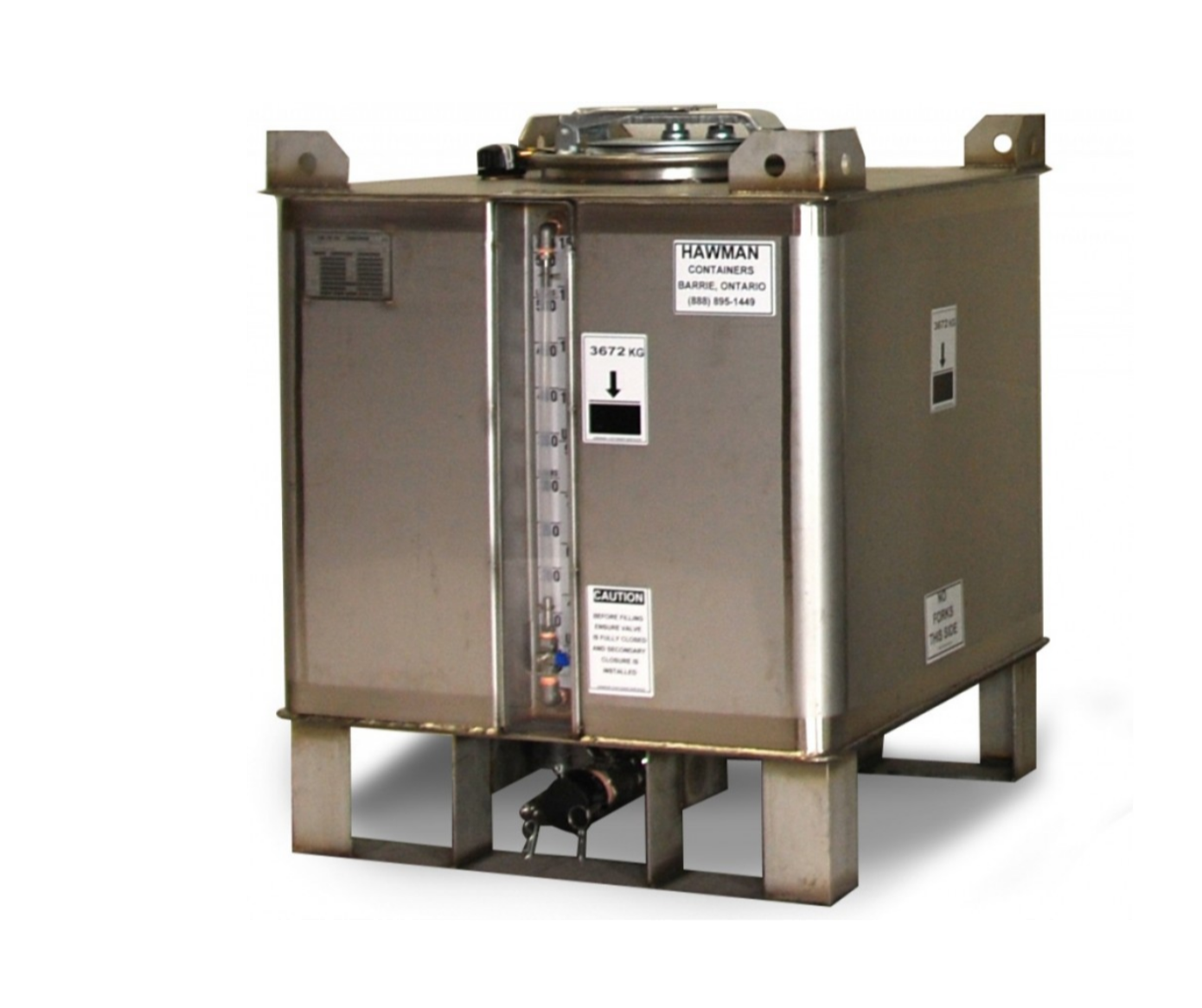
Steel IBC Containers — Advantages, Trade-Offs, and Best Uses
Materials and Construction
Steel IBCs are welded metal vessels available in carbon steel or stainless steel — typically 304 or 316 grade. They come with external frames, integrated valves (commonly a 2" ball valve), fusible vents, and optional heating or insulation systems. UN31A is the relevant certification standard for metal IBCs in transport service.
Stainless steel is preferred where corrosion resistance, product purity, or sterility is required. Carbon steel is common for general industrial use and fuel storage applications.
Key Advantages
Significantly longer service life: 25+ years with routine maintenance and recertification — a major factor in long-run total cost of ownership
Superior fire performance: Steel does not melt or release contents the way HDPE does — it is required for Class I flammables and recommended wherever fire risk is elevated
Higher impact and puncture resistance: Welded steel walls outperform HDPE liners in mechanical durability, even caged ones
Wide temperature tolerance: Suitable for hot-fill applications and high-temperature process storage that would damage polyethylene liners
Better chemical compatibility: Handles solvents and reactive materials that attack HDPE
Pharmaceutical and high-purity use: Stainless steel offers zero-leach, non-porous surfaces and supports clean-in-place (CIP) sterilisation
Recyclability: Steel is highly recyclable, and long service life reduces total material throughput
Trade-Offs
Higher upfront cost: $3,000–$5,000+ per unit depending on grade and configuration
Heavier than poly IBCs, which increases transport weight and may require heavier-duty handling equipment
Carbon steel requires corrosion protection for many chemical applications
Some aggressive corrosives — such as hydrofluoric acid — are incompatible with standard steel grades, so compatibility must be confirmed
Steel IBC Pros and Cons
| Factor | Steel IBC |
|---|---|
| Upfront cost | High ($3,000–$5,000+) |
| Weight | Heavier |
| Chemical resistance | Excellent for solvents and reactive chemicals |
| Temperature limit | Very wide range; suitable for hot-fill |
| Fire performance | Excellent |
| Service life | 25+ years typical |
| UN certification available | Yes (UN31A) |
| Food-grade / pharma use | Yes (stainless steel, CIP-capable) |
Which Industries Use Each Type?
Where Steel IBCs Are Typically Specified
Oil and gas: Fuel storage, diesel, and Class I flammable liquid transport — poly IBCs are not appropriate here
Chemical manufacturing: Solvents, reactive chemicals, and high-temperature process liquids
Pharmaceutical and laboratory: APIs and high-purity ingredients requiring sterile, non-porous, CIP-capable containers — stainless steel 304/316 is the standard
Food and beverage (high-value applications): Breweries, wineries, and food processors where sterility or CIP cleaning is required
Mining and heavy industrial: High-throughput operations where long service life and mechanical durability justify the capital cost
Where Poly IBCs Are Commonly Used
Agriculture: Fertilisers, pesticides, herbicides, and crop protection chemicals at ambient temperatures
Chemical distribution: Many corrosive acids and alkalis at moderate temperatures where HDPE compatibility is confirmed
Food and beverage (general): Edible oils, syrups, and non-reactive food ingredients where CIP is not required
Water treatment: Liquid treatment chemicals and additives at ambient temperatures
Temporary or lower-throughput storage: Where shorter service life is acceptable and lower capital cost is the priority
Material Recommendation by Application
| Application | Recommended Material | Key Reason |
|---|---|---|
| Class I flammables (acetone, methanol, toluene) | Stainless steel | Fire performance requirement |
| Diesel and fuel storage | Carbon or stainless steel | Flammability, regulatory requirement |
| Pharmaceutical APIs | Stainless steel (304/316) | Sterility, zero-leach, CIP |
| Corrosive acids/alkalis (ambient temp) | Poly (HDPE) | Cost-effective, broadly compatible |
| Agricultural chemicals | Poly (HDPE) | Lightweight, economical |
| Edible oils and food-grade liquids (CIP required) | Stainless steel | Sterility, product purity |
| Edible oils and food-grade liquids (no CIP) | Food-grade HDPE | Economical, compliant |
| High-temperature process liquids (>60°C) | Steel | HDPE temperature limit exceeded |
| Long-term, high-throughput industrial storage | Steel | Lifecycle cost advantage |
Why Industrial Operators Choose Heavy-Duty IBC Systems
Total Cost of Ownership
The upfront price is only part of the equation. A poly IBC at $300 replaced every seven years costs more over a 25-year period than a metal IBC at $4,000 that runs for the same duration with maintenance and periodic recertification. For high-throughput operations, that math becomes even more favourable.
Reconditioning and recertification extend service life and spread capital cost — which is a key reason Hawman offers IBC reconditioning services alongside new container manufacturing.
Regulatory Compliance
Both steel (UN31A) and composite (UN31HA1) IBCs can be certified for hazardous goods transport requirements when they meet design and test criteria. In Canada, IBCs used for dangerous goods transport must comply with CAN/CGSB-43.146. Transport-use IBCs also require periodic retesting — every 30 months (2.5 years) — to retain UN and Transport Canada certification.
Operational Checklist
Before procuring any IBC, work through these basics:
Verify UN/Transport Canada certification and retest schedule for any IBC used in transport
Confirm chemical compatibility and maximum fill temperature before procurement
Plan secondary containment sized for the volume of the largest IBC on site
Schedule regular valve, gasket, and seal inspections for both steel and poly units
Protect poly IBCs from UV exposure and avoid stacking configurations that concentrate wall stress
For steel units, inspect for corrosion and ensure coating or lining integrity is maintained
Hawman Steel and Composite IBC Solutions
Our Metal IBC Line (UN31A Certified)
We manufacture steel-frame metal IBCs in both carbon steel and stainless steel — including 10-gauge stainless construction — certified UN31A and built to CAN/CGSB-43.146. Our metal IBCs are designed for 1.9 SG product, stackable up to four high, with 24+ approved designs for hazardous and non-hazardous liquids.
Custom configurations are available: valve options, lid types, hopper bottoms, heating systems, frame modifications, and internal coatings. These containers are built for flammable liquids, corrosives, solvents, fuel storage, and high-temperature process applications.
Our Composite IBC Line (UN31HA1 Certified)
Our composite IBCs combine a steel structural frame with a polyethylene liner, certified UN31HA1. They are designed for chemical totes, lubricants, emulsions, and corrosive liquids where HDPE chemical compatibility is confirmed. Lightweight and cost-effective for applications where a long-term steel investment is not required.
Why Hawman IBCs Are Built Differently
Every container is manufactured entirely in-house at our 100,000+ sq. ft. facility in Barrie, Ontario. Engineering, fabrication, testing, and certification all happen under one roof. We have 40+ years of IBC manufacturing experience — and many of the containers we built in the 1990s are still in active service or returning to us for recertification. That speaks for itself.
We are ISO 9001:2015 certified, CWB W47.1 certified for welding, and can provide P.Eng stamped engineering documentation. We ship across Canada, across North America, and to remote locations worldwide.
IBC Reconditioning and Recertification
We offer testing, inspection, cleaning, repair, and recertification for existing IBCs — including safe chemical removal. Reconditioning is a cost-effective way to extend the service life of steel IBCs and keep containers compliant without full replacement.
Making the Right Choice — A Practical Decision Framework
Choose Steel When:
You store Class I flammable liquids, reactive chemicals, or solvents that attack HDPE
Process temperatures regularly exceed 60°C or hot-fill is part of your operation
Sterility, CIP capability, or pharmaceutical-grade purity is required
You need maximum mechanical durability and impact resistance
You are planning for a 20+ year asset lifecycle
Your operation requires Transport Canada or UN-compliant transport of high-hazard dangerous goods
Choose Polyethene IBC Totes When:
You store Class II/III combustibles, agricultural chemicals, or corrosives at ambient temperatures with confirmed HDPE compatibility
Upfront cost and lighter transport weight are the primary constraints
Storage duration is limited or product turnover is high
You need a food-grade container for edible liquids where CIP is not required
Lower-throughput or temporary storage makes a shorter asset lifecycle acceptable
The Bottom Line
There is no single correct answer when comparing steel vs poly IBCs. Material selection depends on what you store, at what temperature, under what regulatory obligations, and for how long.
Steel wins on safety, longevity, and total cost of ownership for demanding applications. Poly wins on upfront cost and weight for moderate-risk, ambient-temperature uses.
The most common mistake is choosing by price alone — without confirming chemical compatibility, temperature limits, and fire class. That shortcut can cost far more than the money saved on the original purchase.
If you are not certain which type fits your application, Hawman Container Services can advise and quote both options.
Request an IBC Quote
Need a UN-certified IBC for hazardous or non-hazardous storage? Hawman Container Services manufactures both steel and composite IBCs in-house in Ontario. Request a custom IBC quote or contact our team directly to discuss your application and get the right container specified for your operation.
Frequently Asked Questions
What is the difference between a steel IBC and a poly IBC?
Steel IBCs are welded metal containers (carbon or stainless steel) certified UN31A, designed for high-risk chemicals, flammable liquids, and high-temperature applications. Poly IBCs use an HDPE liner inside a steel cage (composite IBC, certified UN31HA1) and are better suited for corrosives, agricultural chemicals, and general industrial use at ambient temperatures. The key differences come down to fire performance, temperature limits, cost, and service life.
Can poly IBCs be used for flammable liquids?
Poly IBCs are not suitable for Class I flammable liquids such as acetone, methanol, or toluene. HDPE melts rapidly in a fire, creating a serious pool fire hazard. Steel IBCs are required for Class I flammables. Poly IBCs may be acceptable for Class II or III combustibles depending on certification and compatibility, but this should always be confirmed against current regulatory requirements.
How long do steel IBCs last compared to poly IBCs?
Steel IBCs typically last 25 years or more with routine maintenance and periodic recertification. Poly IBCs generally have a service life of 5–10 years, though well-maintained units in low-stress, low-UV environments may reach approximately 20 years. The longer lifespan of steel IBCs often results in a lower total cost of ownership for high-use industrial operations.
What temperature can a poly IBC handle?
HDPE poly IBCs have a continuous-service temperature limit of approximately 49–60°C (120–140°F). Filling or storing liquids above this range can deform the liner, accelerate chemical attack, or cause stress cracking. Steel IBCs are required for hot-fill applications or high-temperature process storage.
Are both steel and poly IBCs UN-certified for dangerous goods transport?
Yes, both types can be UN-certified when they meet the applicable design and test standards. Steel IBCs are certified under UN31A; composite poly IBCs under UN31HA1. In Canada, transport-use IBCs must comply with CAN/CGSB-43.146 and require retesting every 30 months to maintain certification. UN certification does not automatically mean the container is compatible with every chemical — material suitability for the specific dangerous goods being transported must still be confirmed.